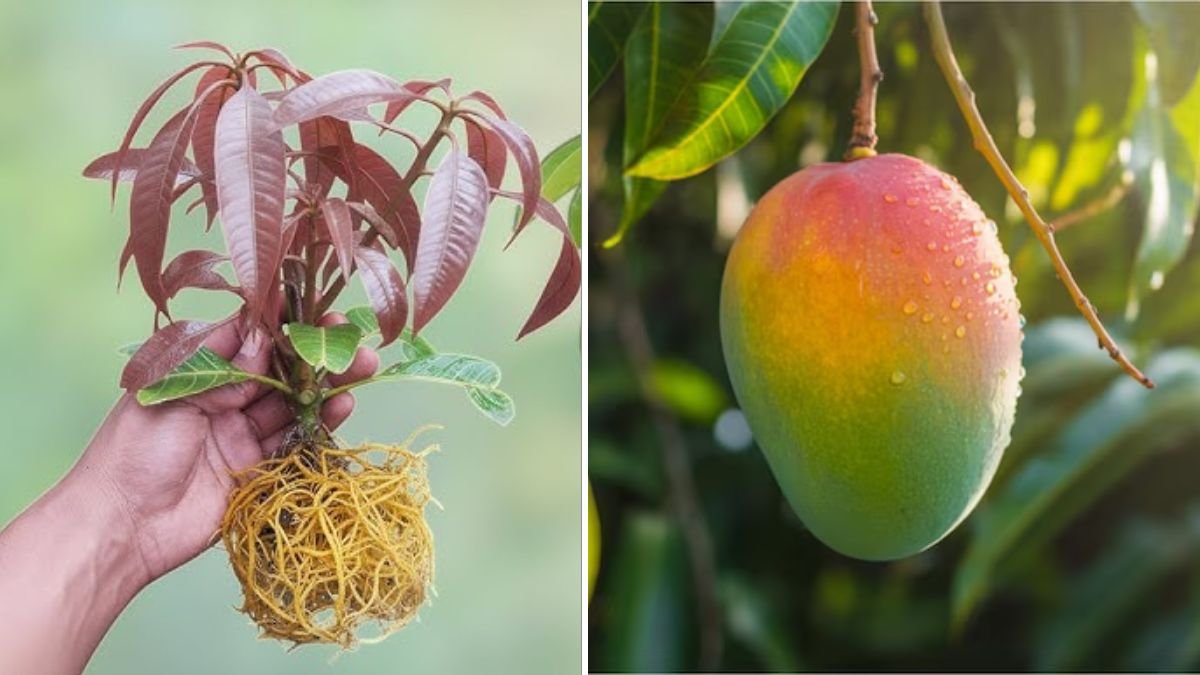
Mango, famously known as the King of Fruits, is cherished worldwide for its rich flavor, fragrance, and versatility. Many gardeners dream of growing their own mango trees, but most believe propagation is difficult or complicated.
The truth is—mango trees are surprisingly easy to propagate when you use the correct technique.
Whether you want to grow a mango tree in your backyard, start a fruit garden, or clone a variety you love, propagation allows you to multiply your trees quickly and reliably. In this article, you’ll discover the simplest and most effective methods to propagate mango, along with expert tips that ensure fast rooting, strong growth, and a healthy, fruit-bearing tree.
Let’s dive into the step-by-step guide that makes mango propagation easy—even for beginners.
Why Propagate Mango Trees?
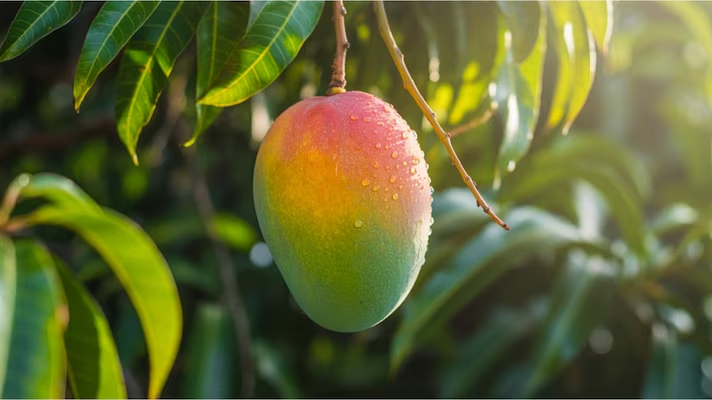
While mango trees can be grown from seeds, they often take longer to bear fruit and may not inherit the qualities of the parent fruit. Propagation solves these issues.
✔ 1. Faster Fruiting
Seed-grown mango trees take 5–8 years to produce fruits.
Propagated ones can fruit in 2–4 years, depending on the method.
✔ 2. True-to-Type Plants
Propagation methods like cuttings and grafting produce an exact clone, ensuring fruit quality remains identical to the parent tree.
✔ 3. Cost-Effective
No need to buy expensive nursery plants—you can create as many trees as you want.
✔ 4. Stronger, Healthier Growth
Grafted or propagated mango trees often show better resistance to pests and diseases.
The Best Seasons for Mango Propagation
Timing plays an important role in rooting success. The ideal seasons are:
- Late Spring (April–June)
- Early Monsoon (June–July)
Warmth, humidity, and active plant growth make these months perfect for propagation.
Top 3 Ways to Propagate Mango Trees (Easy for Beginners)
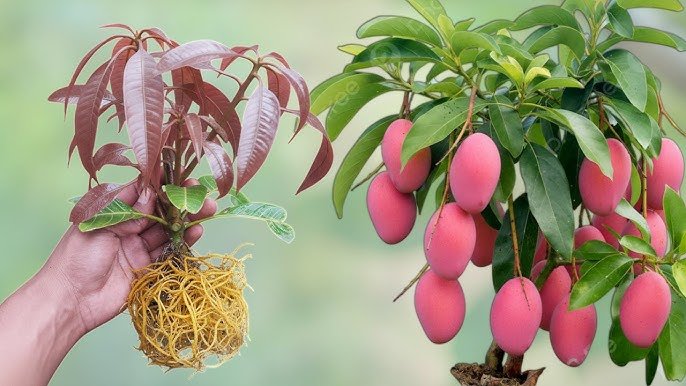
Although there are several techniques, the three simplest and most effective methods are:
- Semi-hardwood stem cuttings
- Air layering (marcotting)
- Grafting (most reliable for fruit quality)
In this article, we’ll focus on the easiest ones for home gardeners, with grafting explained at the end.
Method 1: Propagate Mango from Semi-Hardwood Cuttings (Beginner-Friendly)
Mango cuttings root easily when prepared properly. Follow this professional nursery method for a high success rate.
Step 1: Choose the Right Cutting
Select:
- A semi-hardwood branch
- 7–10 months old
- Pencil-thick
- Healthy, disease-free
Semi-hardwood is ideal because it contains high stored energy and is still flexible enough to root.
Step 2: Prepare the Cutting
Cut a 20–25 cm (8–10 inch) piece with:
- 3–4 nodes
- 2–3 healthy leaves at the top
Remove the lower leaves to reduce moisture loss.
Dip the cut end in:
- Rooting hormone powder (IBA) or
- Aloe vera + honey mix (natural rooting booster)
This prevents fungal infection and stimulates root formation.
Step 3: Prepare the Rooting Medium
The success of mango cuttings largely depends on the soil mix.
Best rooting mix:
- 40% Cocopeat
- 30% Sand or Perlite
- 20% Compost
- 10% Rice husk or wood chips
This provides:
✔ Excellent drainage
✔ Good aeration
✔ Zero waterlogging
Step 4: Plant the Cutting
- Insert the bottom 2–3 inches into the rooting mix.
- Firm the soil gently around it.
- Mist lightly with water.
Step 5: Create a Mini Greenhouse (SECRET STEP)
Cover the pot with:
- A clear polythene bag
- A cut plastic bottle
- A transparent container
This maintains 80–90% humidity—ideal for mango rooting.
Place it in bright, indirect sunlight.
Step 6: Care Until Rooting
Follow this care routine:
- Keep soil slightly moist
- Avoid direct sunlight
- Open the greenhouse cover every 2–3 days
- Spray neem water weekly to prevent fungal issues
Rooting Time: 4–6 Weeks
You will notice:
- New leaves
- Firm stem
- Fresh green buds
- Slow upward growth
These indicate successful rooting.
After 7–8 weeks, transplant the new plant into a bigger pot.
Method 2: Propagating Mango by Air Layering (Fast and Highly Successful)
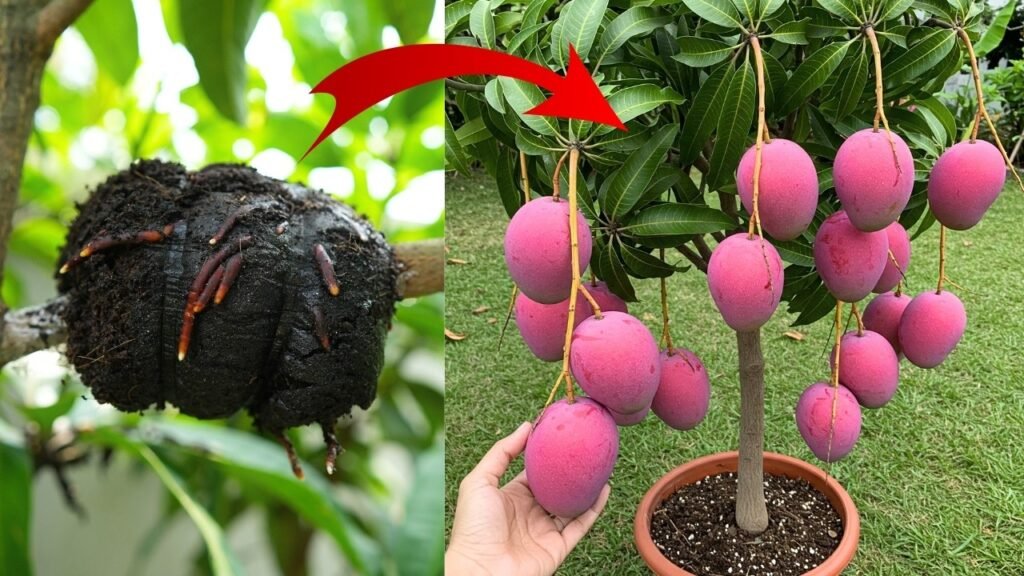
Air layering, also known as marcotting, is one of the easiest and most reliable propagation methods for mango.
This method encourages roots to grow on a branch while it’s still attached to the mother tree, giving it a constant supply of nutrients and moisture.
Step-by-Step Air Layering Guide
✔ 1. Select a Healthy Branch
Choose:
- A 1-year-old semi-hardwood branch
- Pencil-to-thumb thickness
- Free from pests
✔ 2. Make the Cut
Remove the bark ring (about 1–1.5 inches wide).
Expose the inner wood completely—this prevents healing.
✔ 3. Apply Rooting Hormone
Dust with rooting hormone or aloe gel.
✔ 4. Pack with Moist Moss
Wrap moist sphagnum moss or cocopeat around the cut area.
✔ 5. Cover Securely
Use cling film or plastic to seal the moss tightly.
Tie both ends to prevent moisture loss.
✔ 6. Wait for Root Formation
Roots form in:
⏱ 4–8 Weeks
Once you see strong white roots inside the plastic, cut the branch below the root ball and plant it in a pot.
Method 3: Propagating Mango by Grafting (Best for Perfect Fruit Quality)
Grafting ensures:
✔ Faster fruiting
✔ Higher disease resistance
✔ Reliable fruit quality
The easiest grafting method for beginners is cleft grafting or veneer grafting.
Basic Grafting Steps
- Select a healthy rootstock (seedling 1–1.5 years old).
- Choose a scion from your desired mango variety.
- Make a clean cut on both rootstock and scion.
- Fit them together tightly.
- Wrap with grafting tape.
- Keep in partial shade.
Graft union forms in 3–4 weeks.
Caring for Young Mango Plants After Propagation
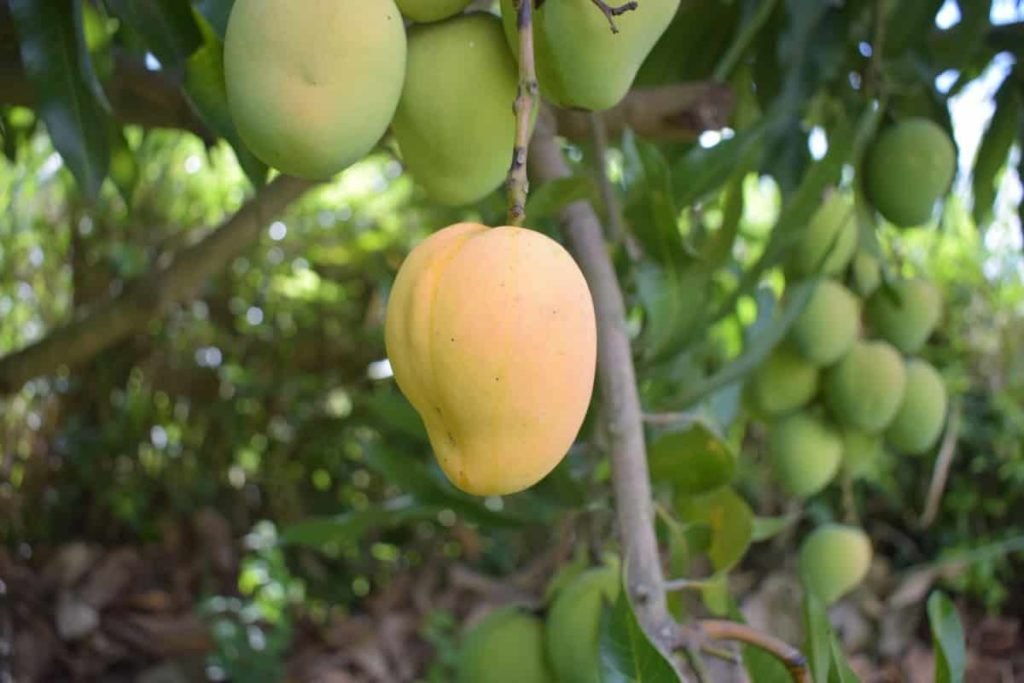
Whether you used cuttings, layering, or grafting, caring for the new plant is essential for strong growth.
1. Provide 5–6 Hours of Sunlight Daily
Young mango plants need bright light but should be protected from harsh midday sun.
2. Water Deeply but Less Often
Allow the soil to dry slightly between waterings.
Overwatering leads to root rot.
3. Feed Monthly with Organic Fertilizers
Use:
- Cow dung compost
- Vermicompost
- Mustard cake fertilizer
- Banana peel extract
This helps the plant grow faster and stronger.
4. Prune to Encourage Branching
Once your plant reaches 1–1.5 feet, pinch the top to promote side shoots.
More branching = more future fruits.
5. Protect from Pests
Spray every 10–15 days:
- Neem oil
- Soap water
- Clove or garlic spray
This prevents common pests like:
- Mealybugs
- Aphids
- Scale insects
When Will the Propagated Mango Tree Bear Fruits?
Depending on the method:
✔ Cuttings: 2–4 years
✔ Grafted plants: 2–3 years
✔ Air-layered plants: 2–3 years
This is much faster than seed-grown trees (5–8 years).
Final Thoughts
You don’t need advanced gardening skills to propagate mango trees. With the right method—whether it’s cuttings, grafting, or air layering—mango propagation becomes surprisingly simple. These techniques ensure you get a strong, healthy plant that grows faster, resists diseases, and produces fruits identical to the parent variety.
Mango trees truly are easier to propagate than most people think, and with a little patience and the steps outlined above, you can grow your own thriving mango orchard right at home.